ARGEvol Conference
From 12 Nov 2025 until 14 Nov 2025 - BIOPOLIS-CIBIO, Vairão, Portugal

Ancestral recombination graphs (ARGs) are structures that describe the transmission of genetic material and contain information on all of the coalescence and recombination events for a set of samples. ARGs have been described as the ultimate record of the evolutionary process and hold a lot of promise for future research in various fields of evolutionary biology. This includes inferring the demographic history of populations, studying natural selection and recombination, and in more applied settings, ARGs could be useful for studies on population connectivity informing conservation actions. However, ARGs still remain underexploited and less known among empiricists. The objectives of the proposed meeting are to fill this gap by introducing the international community to ARGs and to promote collaborative projects further developing and implementing these new approaches.
VENUE
The city of Vila do Conde is a charming coastal small city and several options, from youth hostel to hotels and it is about 25 Km from Porto, the largest town in the north of Portugal, with a metro connecting the centre of the two cities in ~45 minutes.

The Venue of ARGEvol will be at Biopolis headquarters, Quinta to Crasto, in the old village of Vairão, close to Vila do Conde. For participants needing accommodation, we recommend you to stay in Vila do Conde (closest to Vairão) or in Porto (see hotels recommended below). For those staying in Vila do Conde, the organization will provide free transport every day from Vila do Conde to the Venue (and return) for free. For those that prefer to stay in Porto, you will need to take the metro in direction to Vila do Conde (see below) but leave in the Mindelo Metro station, where free transport to the Venue (and return) will be provided for free.

INVITED SPEAKERS
Yun Deng (University of California, Berkeley), Débora YC Brandt (University College London), Daria Shipilina (ISTA Vienna), James Kitchens (University of California, Davis), Yan Wong (BDI, Oxford).
FORMAT
We propose a 3-day meeting to showcase the potential and foster the use and development of methods based on ARGs in evolutionary biology inference. The event will combine different formats, including conference-style sessions featuring talks held by international speakers and practical sessions comprising hands-on workshops. A poster session is also planned, in case you prefer to submit a poster.
PROGRAM
DAY 1 (12 Nov.)
DAY 2 (13 Nov.)
PROGRAM
DAY 1 (12 Nov.)
9:00-9:30 OLD Registration - -
9:30-10:00 OLD Opening Ceremony Organisers
10:00-10:30 OLD Invited speaker 1 Yan Wong Introductory ARG lecture 1
10:30-11:00 OLD Invited speaker 2 Debora Brandt The potential of evolutionary inferences using ARGs
11:00-11:30 OLD Refreshment break
11:30-11:50 NEW Speaker 1 Duncan Robertson Introduction to tskit
11:50-12:50 NEW Workshop 1a Yan & Debora ARGs local trees and genetic variation
12:50-14:15 NEW Lunch
14:15-15:45 NEW Workshop 1b Yan & Debora ARG simplification & simulation
15:45-16:00 NEW Refreshment break
16:00-16:20 NEW Speaker 2 Per Unneberg tseda – a visualization tool for tree sequence exploratory data analysis
16:20-16:40 NEW Speaker 3 Hossameldin Ali Fast SMCK Simulations allow whole Drosophila chromosome simulations in msprime
16:40-17:30 NEW Preparation Organisers Local software installation for DAY2
17:30-19:00 NEW Porto de Honra
DAY 2 (13 Nov.)
9:30-10:00 OLD Invited speaker 2 Yun Deng Current methods for inferring Ancestral Recombination Graphs
10:00-10:20 OLD Speaker 1 Xinger Tang A Pedigree-Based Method for Localization of Recombination Events
10:20-10:40 OLD Speaker 2 Alexander Mackintosh Sampling ARGs from populations that reproduce by partial-selfing
10:40-11:00 OLD Refreshment break
11:00-11:30 OLD Invited speaker 3 Daria Shipilina Applying ARGs across evolutionary biology: insights from model and non-model organisms
11:30-11:50 OLD Speaker 3 Madeline Chase Understanding the temporal dynamics of hybridization in a songbird species complex
11:50-12:10 OLD Speaker 4 Arka Pal Genealogical analysis of replicate flower colour hybrid zones in Antirrhinum
12:10-12:30 OLD Speaker 5 Yu Zhang PigARG: Exploring gene exchange among pig breeds worldwide
12:30-14:00 NEW Lunch
14:00-15:30 NEW Workshop 2 Duncan, Yun & Daria ARG inference & applications
15:30-15:45 NEW Refreshment break
15:45-17:00 NEW Workshop 2 (continued) Duncan, Yun & Daria ARG inference & applications
19:30 VILA Conference dinner
DAY 3 (14 Nov.)
('OLD' and 'NEW') refers to the venue, i.e. either the old CIBIO building or the new CIBIO building (10 min apart by foot).
The abstract book can be downloaded from here
10:00-10:30 OLD Invited speaker 4 James Kitchens Reconstructing the spatial histories of populations from gene trees
10:30-10:50 OLD Speaker 1 Matthieu Pichené ARGWAS: Leveraging Ancestral Recombination Graphs to Infer the Effect of Hidden QTLs
10:50-11:10 OLD Speaker 2 Christopher Talbot ARGscape: Explore ancestry through space, time and the genome
11:10-11:40 OLD Refreshment break
11:40-12:00 OLD Speaker 3 Pierre Lesturgie Effect of deleterious mutations on neutral genetic diversity in geographically structured populations
12:00-12:10 OLD Flash talk 1 Lea Nicolas Parallel evolution of a clinal inversion polymorphism in seaweed flies
12:10-12:20 OLD Flash talk 2 Thomas Brazier How to integrate recombination in population genomics inference?
12:20-12:30 OLD Flash talk 3 Muskaan Muskaan Effects of Ploidy on selection: Insights from mosses
12:30-13:45 NEW Lunch
13:45-15:30 NEW Workshop 3 James Kitchens Reconstructing the spatial histories of populations from gene trees
15:30 15:45 NEW Refreshment break
15:45-16:45 NEW Workshop 3 (continued) James Kitchens Reconstructing the spatial histories of populations from gene trees
16:45-17:30 NEW Round table Panelists: Invited speakers Questions and perspectives
17:30 NEW Closing
The abstract book can be downloaded from here
MAIN ORGANIZATION
Laura Meyer, ISEM-Montpellier, France
Pierre Alexandre-Gagnaire, ISEM-Montpellier, France
Pierre Barry, CIBIO-BIOPOLIS, Portugal
REGISTRATION & ABSTRACT SUBMISSION
Registration is open to all participants, whether you wish to attend only or also submit an abstract for consideration.
Registration closed
Abstract submission is now Closed
Limited places available! Registration is subject to availability and places will be allocated on a first-come, first-served basis.
Fees
Fees: €200 (regular) or €100 (students & postdocs). Payment will be made to Associação BIOPOLIS - VAT No. 516033727.
Registration is free for researchers affiliated with institutions part of the BIOPOLIS TEAMING project (CIBIO and University of Montpellier).
For any questions, please contact:
Scientific inquiries: ruifaria@cibio.up.pt, laura.meyer@umontpellier.fr
Payments & invoices: contabilidade@biopolis.pt
Administrative inquiries: marta.pereira@biopolis.pt
ORGANIZATION

Funding: This project has received funding from the European Union's Horizon 2020 research and innovation programme under grant agreement Nº 857251 and by the Luso-American Development Foundation (GL Proj. 2025/0264)
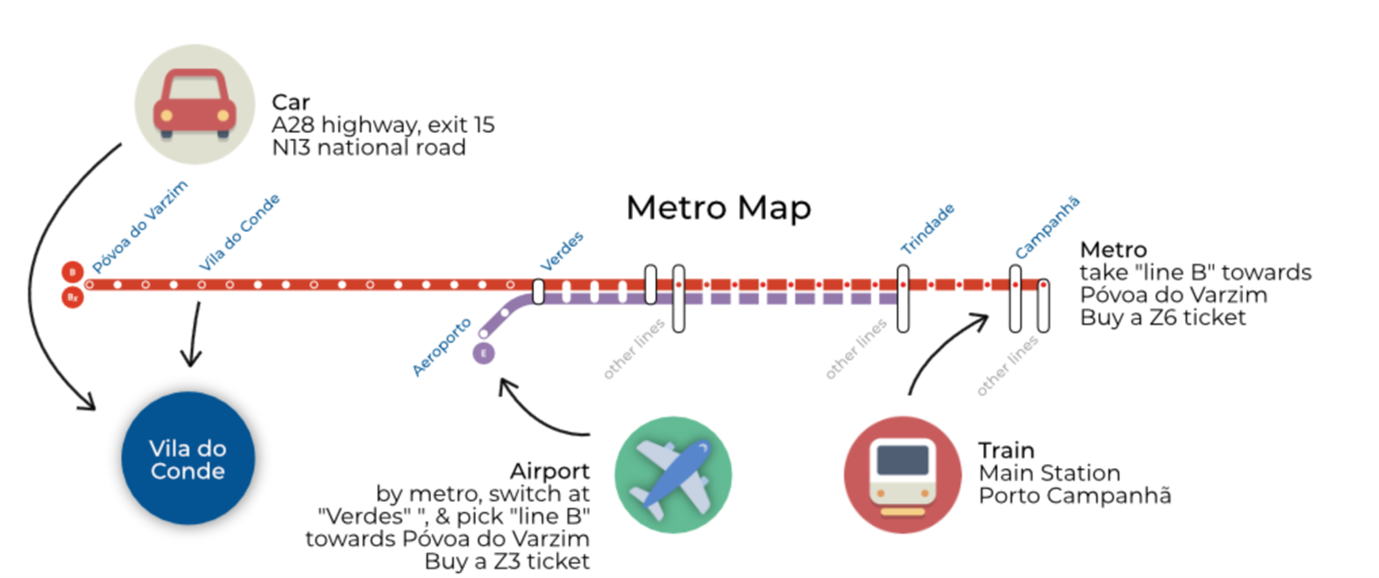
How to get to Vila do Conde
By Car
To drive to Vila do Conde, take the A28 highway, which is easily accessible from Porto or the airport. Head north on the A28 towards Vila do Conde/Viana do Castelo and take Exit 15, signposted "N206 – Vila do Conde”.
By Metro – from Porto
Porto has a direct metro connection to Vila do Conde. Take Line B (red line) toward Porto to Póvoa de Varzim. Get off at "Vila do Conde” station, which is located at a 17-minute walk (1.3 km) from the conference venue. Tickets can be purchased at any station and must be validated before boarding.
More info and timetables here
By Plane
From Porto Airport, take Metro Line E (purple line) and get off at the station "Verdes”. From there, transfer to Line B (red line), toward "Póvoa de Varzim” and exit at "Vila do Conde” station.
Accommodation
Accommodation
We recommend the following hotels in Vila do Conde: